An enriching department fostering critical reading, creative expression, cultural understanding, and intellectual curiosity through literature, language, and interdisciplinary learning.
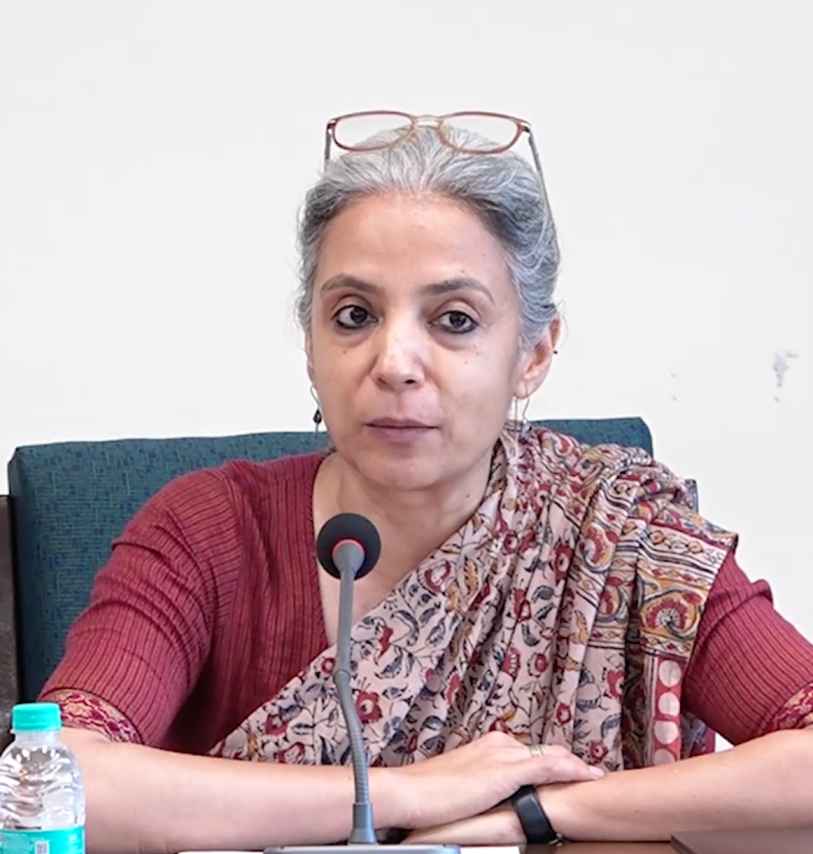
Head of Department
Prof. Karen Gabriel
Overview
Established in 1881, the same year as the College, the English Department of St. Stephen’s College introduces students to ways of reading, critical thinking, and written and spoken expression through courses in literature, culture studies, literary theory, language and communication. Since its inception, English teaching at St. Stephen’s College has functioned as a lynchpin discipline that helps coordinate learning across diverse courses. The department continues to perform this integrative function by catering to students from a wide range of disciplinary backgrounds. The faculty challenge students to refine their intellectual aptitudes while developing language skills, critical thinking and personality. The department values interaction between faculty and students through extra and co-curricular activities.
Teaching and Learning
The department adapts the Delhi University syllabus through extensive tutorial readings and focuses on skillbuilding, perspective formation and exposure to literature with an ethical outlook. Interactive and participative teaching methods contribute to students’ critical and creative abilities and encourage all-round personality development.
Course Structure
The department follows the Undergraduate Curriculum Framework (UGCF-2022) and offers courses for B.A. English (Honours), English Major/Minor for the B.A. Multidisciplinary Programme, as well as Generic Electives, Skill Enhancement Courses and ValueAdded Courses.
B.A. English (Honours) students take three discipline-core papers each semester which train them in literary studies across periods and genres. Introductory courses such as ‘Introduction to Literary Studies’, ‘European Classical Literature’ and ‘Indian Classical Literature’ introduce students to a range of authors, texts and theoretical approaches. The core courses on British Literature include era specific courses such as ‘14th - 17th Century British Poetry’ and ‘Eighteenth Century Literature’ which familiarise students with ideas and texts from an era. In addition, students explore Shakespeare, Romantic and Victorian poetry, and a variety of novels. The programme has components of Indian literature in English, as well as in translation. Students also have the opportunity to explore courses from other diverse literary landscapes, including American, African, and Latin American literature. The syllabus includes courses that focus on sensitive social concerns pertaining to marginalised segments, such as Dalit Writings and Disability. Discipline Specific Electives include courses such as ‘Literary Theory’, ‘Children’s Literature’, ‘Partition Literature’, ‘Literature and Human Rights’, ‘Graphic Narratives’, ‘Dystopian Writings’, ‘Speculative Fiction’, ‘Genre Fiction’ and ‘Film Adaptations of Literary Works’. These courses enable students to pursue specialized or emerging areas of study. The Department also offers a Research Methodology course designed to equip students with essential research and academic writing skills.
Courses available to students from other programmes (SECs and VACs) include ‘Creative Writing’, ‘Communication Skills’,’ Ecology and Literature’, ‘Social and Emotional Learning’, ‘Content Development and Media for Children’, and ‘Visual Communication’. These are especially geared for a skill based learning experience.
Course Progression / Scope
For those who are aiming for higher studies in literature, there is an option to proceed to a fourth year in which students can pursue either a dissertation or an academic project in addition to their core courses and additional electives. The dissertations and projects are tracked and assessed by various committees like Subject Research Committee, and Departmental Research Committee.
In the B.A. Multidisciplinary Studies programme, students who opt for the fourth year consolidate their interdisciplinary training through focused study in a chosen discipline from their previously studied core areas. During this stage, students pursue advanced discipline-specific courses and electives, along with a dissertation or academic project or a combination of additional courses. For this group of students, the fourth year culminates in the award of the four-year Honours degree.
Graduates from the department typically pursue careers in research and teaching, media and advertising, language teaching, civil services, publishing, advocacy and creative fields like literature, film, theatre and music.