An intellectually rigorous department fostering analytical thinking, quantitative skills, research, and a deep understanding of economic theory, policy, and real-world economic issues.
Head of Department
Mr. Sanjeev K.Grewal
Overview
The Department of Economics teaches core and elective papers for two undergraduate programmes, namely, BA (Honours) Economics and BA Multidisciplinary Programme with Economics as the major or the non-major discipline. The coverage and level of academic sophistication in these courses is at par with the undergraduate Economics programmes in some of the best universities in the world. In addition, the Department also offers Generic Elective courses for all the students of the college who have not chosen Economics as one of their core disciplines. The department may also offer some Skill Enhancement and Value Addition courses, which are open to all undergraduate students of the college.
Teaching and Learning
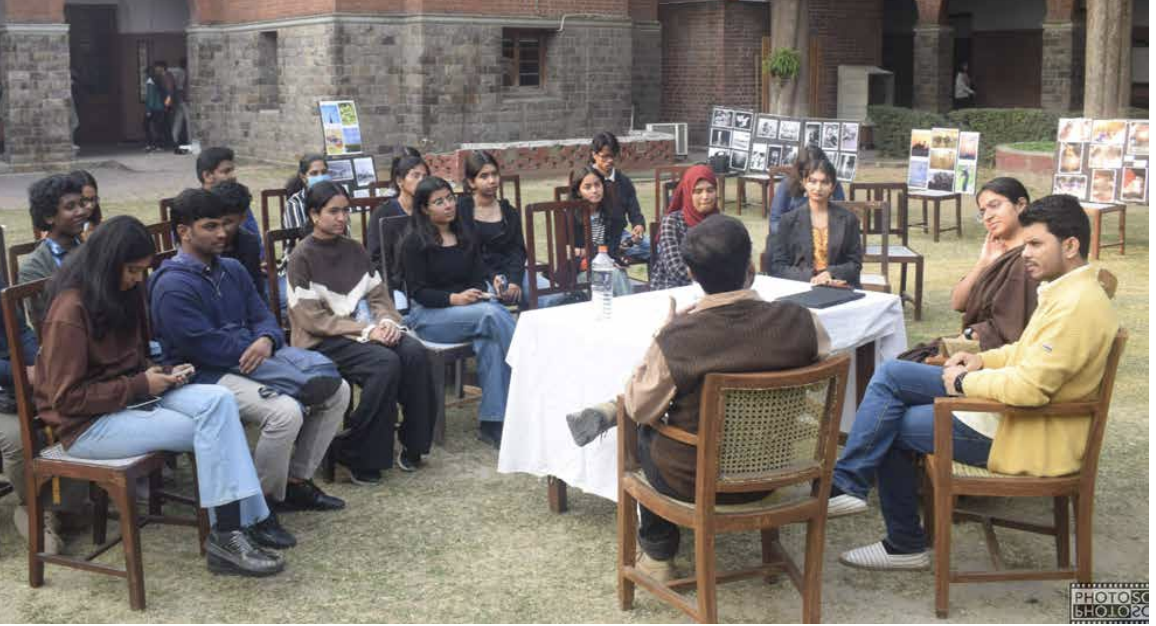
Teaching and learning in the Economics Department is highly interactive and participative. In addition to attending regular classes, students do independent research projects and take part in seminars, discussions, workshops and internships. A very important constituent part of the Economics Department is the Centre for Economic (CER) Research, The Centre for Economics Research organizes regular seminars and workshops for the faculty and students and invites leading scholars from prestigious institutions to present their research. The Centre also runs the Goutham Krishna Research Fellowship which offers students an opportunity to undertake primary research under the mentorship of a faculty member. The Rural Research Program (RRP) was conceptualised in 2018-19 around the discussion on rural distress and the agricultural crisis. The program involves field visits by teams of students undertaking primary research and the presentation of the findings in the form of a report and seminar. Overall, the course is technically demanding and requires strong mathematical and quantitative skills. It is not a simple extension of the Economics that a student may have studied in school, and it is not primarily descriptive in character. In many respects, it has more in common with the physical sciences in its reliance on model-building as a guide to the “real world”. The empirical testing of models (“theories”) requires sophisticated statistical tools. Students who want to apply to the BA (Honours) Economics program should have been very comfortable with the Class XII mathematics.
Course Structure
In the BA (Honours) Economics program, the major constituent units (Discipline Specific Core courses or DSCs) of the first two years (the first four semesters) are (1) Mathematical Methods, (2) Statistical Methods and Econometrics, (3) Microeconomic Theory, and (4) Macroeconomic Theory. Semesters 5 and 6 in the third year of the BA Honours Programme build on the techniques developed over the first two years. Compulsory core courses (DSCs) in these semesters include advanced courses in Microeconomics, Macroeconomics, the Indian Economy, International Trade, and Development Economics.
A student of BA Honours in Economics has the option to choose elective papers (Discipline Specific Electives or DSEs) in Economics after the first year of the Honours programme. The range of options for these papers is very wide, and includes, among others, papers like Law and Economics, Open Economy Macroeconomics, Game Theory, Public Economics, the Economics of Health, the Economics of Education, Environmental Economics, Gender and Development, Research Methodology for Economics, Financial Economics, Money and Financial Markets, Industrial Organization, Corporate Finance, Causal Inference, and several courses in advanced and applied Econometrics. For the BA Programme Multidisciplinary Studies, the Department offers courses on Introductory and Intermediate Microeconomics, Introductory and Intermediate Macroeconomics, Introductory Development Economics, and Indian Growth and Development for students who choose Economics as a non-major (minor) discipline. Students who choose Economics as their major discipline do, in addition to courses done by the students who choose Economics as a non-major discipline, courses on Basic Mathematics for Economic Analysis, Optimization for Economic Analysis, Basic Statistics and Basic Econometrics. Economics Major students are also required to do follow-up courses on Intermediate Microeconomics and Intermediate Macroeconomics as their core courses. In their 3rd and 4th years of study, the BA Multidisciplinary students can do any of the Discipline Specific Elective courses available to BA Economics Honours students, provided they satisfy the prerequisites for these courses.
Depending upon student interest and availability of faculty, the Department may offer the following General Elective courses which are open for all the students of the college who do not have Economics as one of their core disciplines: Principles of Microeconomics I, Basic Development Economics, Principles of Macroeconomics I, Indian Economy, Basic Statistics for Economics, Principles of Microeconomics II, Money and Banking, Education and Development, Basic Resource and Energy Economics, Sectoral Issues in Indian Economy, Game Theory and Social Sciences, Basic Environmental Economics, Law and Development, Public Finance in India, Health and Development, and Principles of Macroeconomics II. Depending upon student interest and availability of faculty, the Economics Department may offer one or more of the following Skill Enhancement Courses (SEC), Financial Modelling with Excel, Latex Typesetting for Beginners, and Statistics with R and the Value Added Course (VAC) Financial Literacy. The SEC and VAC courses offered by the department are open for all the students of the college, including those who have Economics as one of their core disciplines.
Career progression/Scope
A significant proportion of the graduating class pursues higher studies in Economics in India or abroad. There is a very distinguished list of former students of the Department who have gone on to hold senior positions as economists or officers in the Government of India, the World Bank, the Asian Development Bank or the International Monetary Fund. Many are in teaching positions at leading universities in India (the Delhi School of Economics, Indian Statistical Institute, Jawaharlal Nehru University, etc.) or abroad (Oxford, Cambridge, Columbia, Cornell, Carnegie-Mellon, Brown, Michigan, the London School of Economics– the list is very long). A very large number of students has also chosen careers in public service and some have reached the highest levels of policymaking in the government as officers or ministers. Many students go on to do Management Studies at one or the other of the business schools, and thence to the corporate sector. A very large number of top executives of leading multinational companies and many captains of the Indian industry studied Economics at St. Stephen’s College. Many former students have distinguished themselves in the field of Law. A fair proportion of students get jobs immediately after the undergraduate degree.